
.webp)
Abmahnung Protection: The Top 5 Marketing Claims that get K-Beauty Sued in Germany
Germany's Abmahnung system allows competitors and watchdogs to issue formal warnings to brands for minor marketing slips. These aren't friendly reminders—they are legal cease-and-desist orders. If you get one, you'll likely have to pay immediate legal costs and sign a binding agreement to pay massive fines for any future repeat offenses.
For K-beauty brands, which often use evocative, high-tech, or "skin-changing" storytelling, the transition to the German market is a legal minefield. As we move through 2026, German courts and the competition watchdog (Wettbewerbszentrale) are specifically targeting five areas where K-beauty marketing often overreaches.
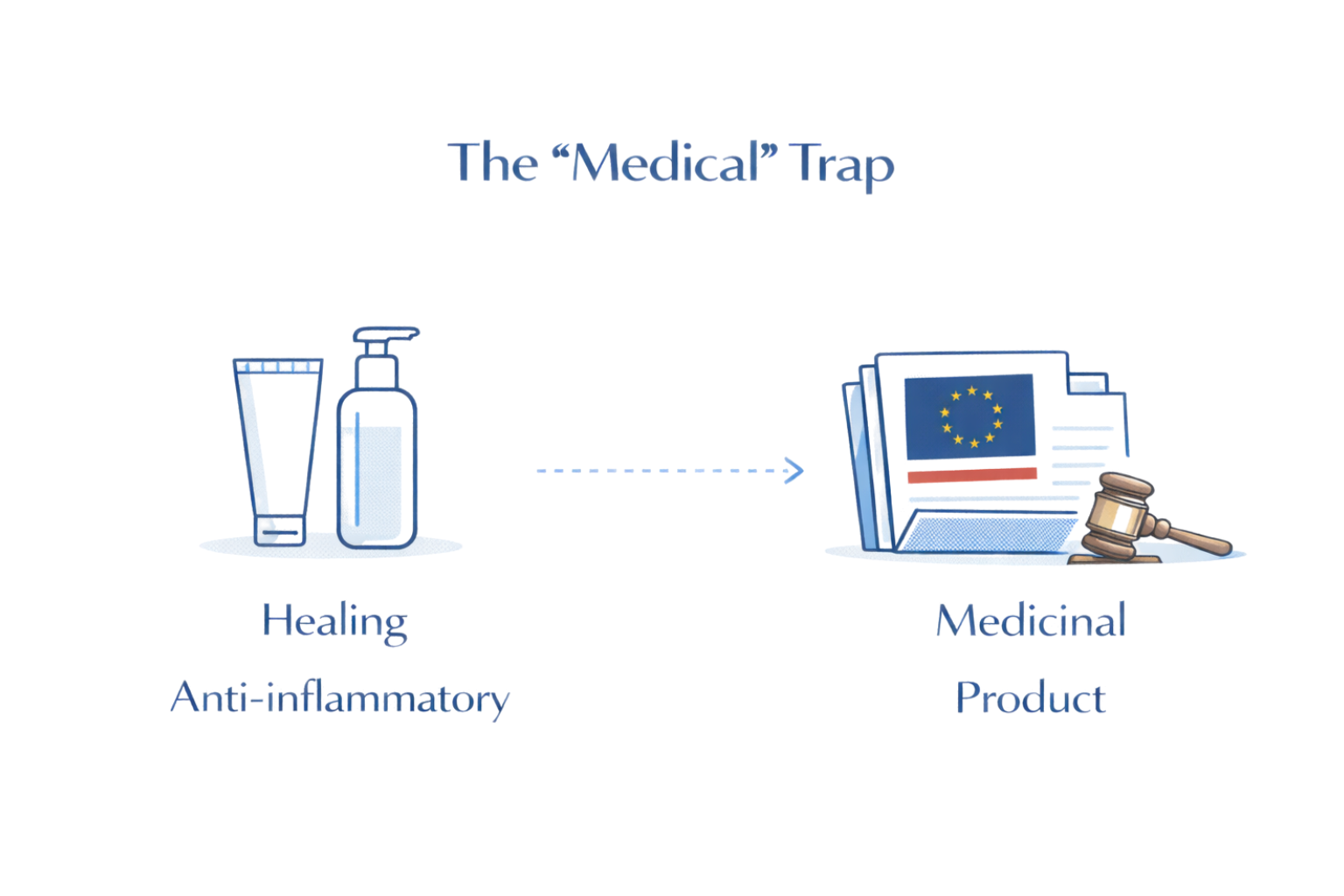
The "Medical" Trap: "Healing" and "Anti-Inflammatory"
K-beauty often positions skincare as a bridge to dermatology. However, in Germany, the line between a cosmetic and a drug is razor-sharp. If a product claims to "heal" skin or to provide a medical-grade effect such as "anti-inflammatory," it risks being reclassified as a medicinal product.
Under the German Act Against Unfair Competition (UWG), a cosmetic cannot claim to cure or prevent disease. Even a common K-beauty term like "soothes inflammation" is dangerous. German regulators prefer "soothes redness" or "cares for stressed skin." If the claim describes a physiological change rather than a purely aesthetic one, it is an open invitation for an Abmahnung.
"Microneedling in a Bottle" and Spicules
The 2025–2026 trend of "liquid microneedling" (using silica spicules to create a tingling sensation) is a significant target. Claims that these products "penetrate the dermis" or "mimic microneedling procedures" are legally high-risk.
If the claim is valid, the product may be legally classified as a medical device or a drug, not a cosmetic.
If the claim is false or exaggerated, it is deceptive advertising. German case law is strict: "microneedling" is a physical procedure. Describing a topical cream with this terminology is misleading to consumers, regardless of how "spiky" the formula feels.
"Clean Beauty" and the "Free-From" Ban
While "Clean Beauty" is a massive marketing pillar in Seoul, German authorities consider the term largely misleading because it has no legal definition. More importantly, "Free from Parabens" or "Free from Silicones" claims are increasingly sued under the "Fairness" criteria of EU Regulation 655/2013.
You cannot market the absence of an ingredient to imply that authorized, legal ingredients are "unsafe." If a K-beauty brand advertises as "Toxin-Free," it indirectly denigrates the entire industry's safety standards. This is a prime reason competitors send warning letters, as it creates an unfair competitive advantage through fear-mongering.
"Clinically Proven" Claims
K-beauty brands often rely on studies from Korean labs, but German regulators require more rigorous testing. To claim something like "reduces wrinkle depth by 20%," your Product Information File (PIF) must document testing that meets specific EU-standard protocols. If the data isn't accessible or compliant with local standards, the claim is a legal liability.
If the study used a small sample size or wasn't conducted on a skin type representative of the German market, the claim is considered "unsubstantiated." Lawyers often request these studies. If the brand cannot produce a compliant report within days, they face a court-mandated injunction.

Environmental Claims & Greenwashing (New for 2026)
Starting in late 2026, the Empowering Consumers Directive will tighten German law, effectively banning vague environmental labels like "Eco-friendly," "Green," or "Climate Neutral." To use these claims, brands will have to prove "recognized outstanding environmental performance" for the entire product—not just a single ingredient.
For K-beauty brands that use these buzzwords on their packaging or social media, the window for vague sustainability claims is closing. Specific, verifiable data or a recognized EU certification must now accompany any green claim.


Berlin Office : Dunckerstr 83. 10437 Berlin
Warehouse: Alexander-meißner str 77B 12526 Berlin


